
Center Stage: Ro Reddick Memory and Manipulation — A Cold War Choir Practice
At Black Girls Do Theater, we are always interested in the moment where memory meets ideology — where personal history collides with political machinery. In Cold War Choir Practice, playwright Ro Reddick invites us directly into that collision.
Drawing from her 1980s upbringing in a Syracuse children’s peace choir, Ro crafts a story that explores the thin line between nostalgic innocence and the complex systems shaping Black survival in Reagan’s America. The play centers on Meek, a young girl navigating Soviet pen pals, shifting family allegiances, and a quietly manipulative Speak & Spell — all while the adults around her recalibrate their relationship to power. What emerges is a deeply human portrait of a Black family adapting in real time to ideological change.
For this edition of Center Stage, we sat down with Ro to talk about trusting the “insistent” memories that won’t let you go, writing into questions rather than easy clarity, and the detective work of interviewing family to capture the emotional precision of 1987. We explored the “switch” into adulthood, the urgency of survival, and how theater allows us to find poetry in the explosions that shape us.
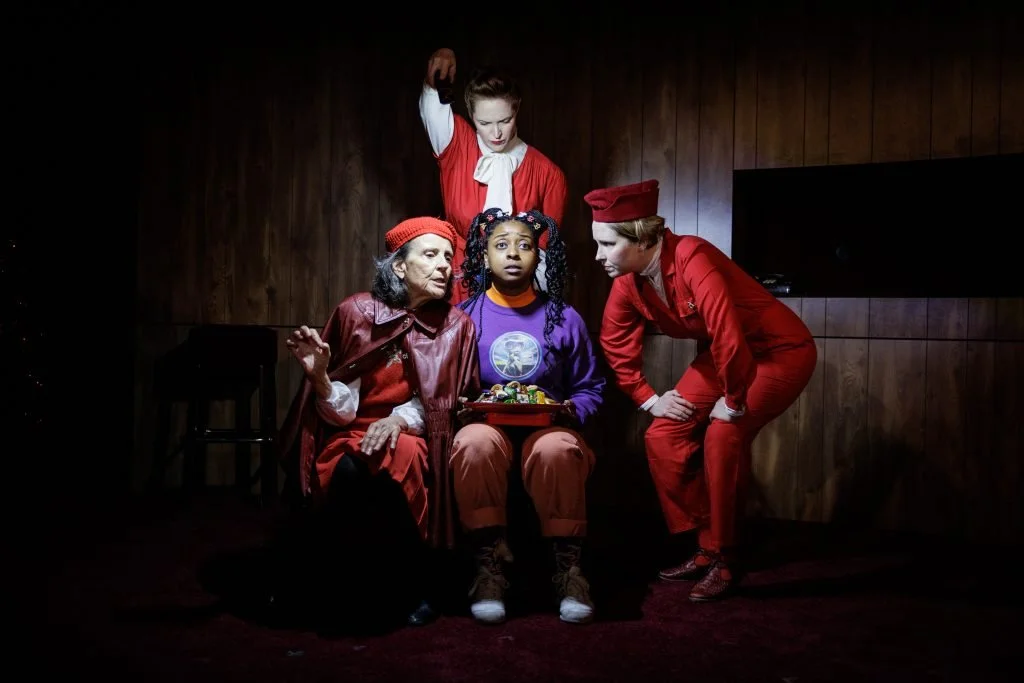
Photos by Marina Baranova
Renee: So Ro, you grew up in 1980s Syracuse singing in a children's peace choir—a detail that feels almost cinematic on its own. For you, when did you realize that this memory wasn't just nostalgic, but also theatrical? When was the moment you knew that memory would become Cold War Choir Practice?
Ro: Well, I was in grad school when I started working on this, and stuff was going on with Russia and Ukraine that was making me think a lot about the eighties and the Cold War. In the fall semester, we were supposed to be writing solo shows under Stacey Karen Robinson, but I just started working on this instead because the memories were so insistent. I had taken a class that spent a lot of time talking about the Cold War, so it was just in the air. I couldn't ignore it. It felt like a very juicy way into that time period and the questions I was interested in.
Renee: Can you talk a little bit more about your time in this children's peace choir?
Ro: Yeah, I was younger than the character in this play, so my memories are really around the songs we sang—I can still remember some of them. I can still remember some of those songs. I didn't want to license those songs, so the reason there is original music is because I wanted to capture the spirit of them and make my own version. Most of all, I remember where we met. We met at the zoo for some reason, and I remember my best friend’s mom would pick me up. At that age, you just do the activities grown-ups set up for you. There were also teenagers who would come back after a cultural exchange in Russia telling all these stories, and a memory I had from that made it into the play as well.
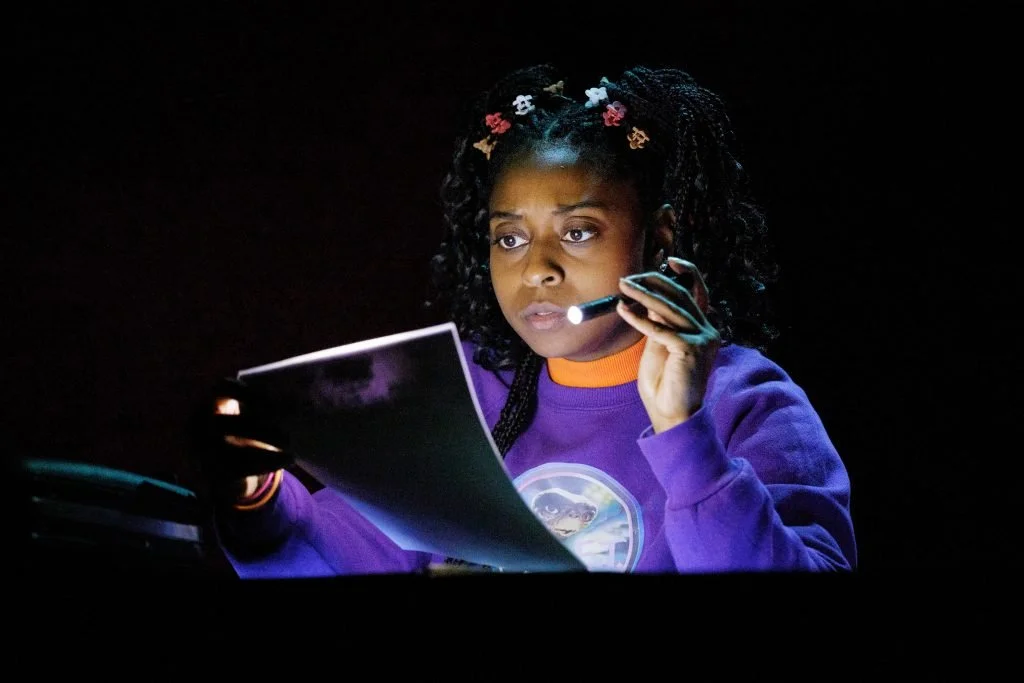
Photos by Marina Barinova
Renee: The idea of children in a peace choir having Soviet pen pals already blurs the line between innocence and ideology. Then you introduce this Speak & Spell character that nudges Meek towards espionage. What drew you to using something so playful and nostalgic as a vehicle for political manipulation?
Ro: I was toying with other choices during INCUBATOR, a thing in grad school where you write a bunch of stuff really quickly and play with MFA actors and directors. It’s a way for us to do quick experiments. I wrote a little game for Simon Says and was thinking about all these 80s toys, but the Speak & Spell remained because I was doing a lot of reading around cybernetics and early computers. There was something about the way it operates when it’s working as intended that felt like a useful tool and something interesting to play with.
Renee: I’d love to talk more about the family—Puddin, Smooch and Clay. In centralizing this story within a Black family, what felt most daring for you? I’m curious about the exchange after the fight between Smooch and Clay. Clay now works for the White House and Smooch realizes he doesn't even feel like he knows his brother anymore.
Ro: I was interested in families where there are socioeconomic and ideological differences. I was really curious about Black conservatives who used to be Black nationalists. I was just really curious about that kind of "switch." The Reagan era felt like a rich time to explore how people align themselves with power and structures. Looking at those two brothers and how they evolved over the decades was fascinating to me.
Renee: Every character in this play is trying to engineer a future that feels safer than their present. What does it mean to dramatize that survival instinct in a Black family? Do you feel like we are still raising children who are quietly preparing for a catastrophe?
Ro: I mean, aren't we all quietly preparing for a catastrophe? That feels like a top-of-mind concern for me, which is why putting Meek at the center felt right. I’m trying to work out my own feelings around safety and when you first come to understand that. I think we are definitely preparing children and ourselves for catastrophe; it’s very dark, but that is sort of the mood.
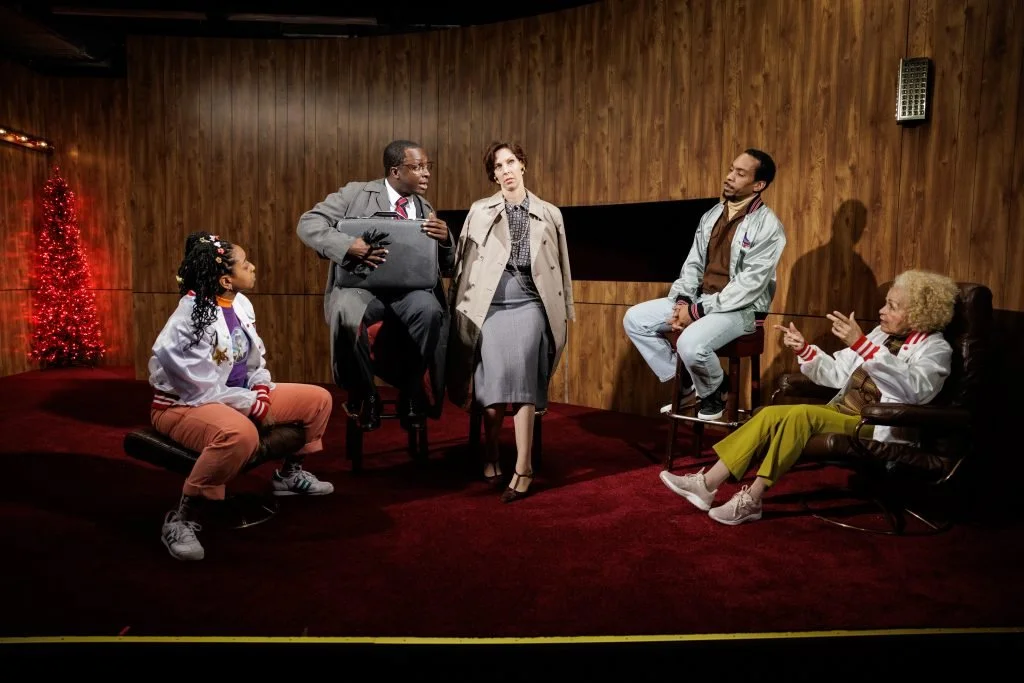
Photos by Marina Baranova
Renee: What did writing this play clarify for your own voice as a playwright?
Ro: It’s probably the biggest thing I’ve ever written in terms of moving parts. I don't know if I ever write towards clarity; I always just write into the questions and the characters. I like it when I end up experiencing an emotion in a different way. When I watch Meek near the end of the play, I feel like I'm processing my own feelings.
Renee: Yes, Meek! How has her character changed over the development of this play?
Ro: In early drafts, it felt more like an ensemble piece. Through development, she really just blossomed into the story. She grew to fill the play in a way that I’m really happy with. She is it.
Renee: There is that moment where she returns to the Speak & Spell after the explosion and asks, "Where were you?" She isn't asking for a "new life," but for immediate needs—money. It’s a powerful moment of a child negotiating with larger powers to survive.
Ro: When I was in the early stages, I interviewed my brother and cousins who remember 1987 with a clarity I don't have. My brother told me about a film they saw in school about a nuclear attack that terrified him, but then he realized no one in our family was hand-wringing about a bomb. There were more immediate concerns at hand. Those day-to-day survival needs really eclipse the abstract threat of nuclear war. Part of Meek’s journey is learning where to locate the actual threat, which she discovers by her last conversation with the Speak & Spell.
Renee: The final image: fireballs falling from the sky, the desire to disappear into secret places—the language feels almost mythic. How did you go about shaping that?
Ro: Because the play was promising a bomb, I knew there would be a series of explosions. I wanted that last explosion to be about Meek moving from the realm of childhood to a slightly more mature place. There was something violent and beautiful about fireballs getting stuck in the snow. She’s processing what she’s been through and using language she’s metabolized from other characters. It’s a moment of growth and realization that just felt right to express through broader poetry.
Renee: What do you hope the audience leaves with?
Ro: I hope it allows a pocket for people to reflect on their own vulnerability and youth. We all have to make that "switch" into adulthood and learn how to navigate the danger of the world. It’s a nice thing to hold space for.
We’re co-hosting a special affinity night for Cold War Choir Practice with our friends at Black Artist Network, in partnership with Clubbed Thumb, Page73 and MCC Theater. Join us for an evening of sharp writing, layered performance, and post-show resonance.